
1 Introduction
The Swedish Government wants Sweden to be “among the world’s top ten nations in the area of AI” (2026, p. 7) and describes how “For example, AI can contribute to research and innovation that strengthens Sweden’s competitiveness” (2026, p. 6). The strategy is politically intelligible: at a time when technical platforms and computing capacity rapidly redistribute economic power, “AI” becomes a word for the future --- sovereignty, productivity, and security.
But precisely for that reason, the strategy must be read with a different question than the one it poses itself. Not “how quickly can we roll out AI?”, but: what kind of knowledge system are we in the process of institutionalizing?
That question is epistemological before it is organizational. It matters what we mean when we say a system “can contribute” to innovation and welfare. Is “AI” here an actor with judgement and inventive capacity, or is it a model that produces likely statements within a bounded representational space? The Swedish Government’s text repeatedly slips between these two pictures, and it is in that slippage that the strategy’s most risky assumptions are born.
2 Background
To make that slippage visible, we have to start from a banal but decisive point: language models are models. A language model (LLM) is, strictly speaking, a system that approximates a probability distribution over the next token given a textual context. It does not produce statements by testing them against the world, but by continuing a sequence in the statistically most plausible way given its training. That does not mean it is always wrong; it means its successes and failures must be understood as model behavior, not cognition.
Here the word predictive is central --- and easy to misunderstand. I will therefore use predictivity in two distinct senses.
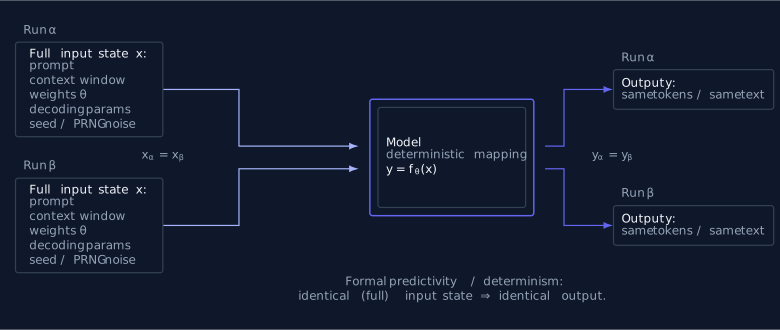
First: formal predictivity, i.e. determinism. Given identical input --- and here everything counts as input: the prompt, the context window, the model weights, decoding parameters, the seed, and any pseudo-random noise --- the model produces the same output. At that level the system is “fully predictable”: there is nothing mystical about why it answers the way it does. Our practical difficulty in reconstructing and interpreting every internal representation is a question of scale and interpretability, not of principle.
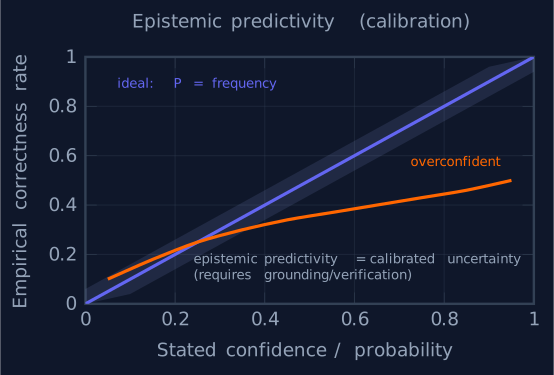
Second: epistemic predictivity, i.e. predictive value. This is the sense people usually mean when they hear “AI in research and innovation”: that the system produces reliable conclusions about the world; that its errors can be calibrated; that its uncertainty is meaningful; and that its claims stand in a robust relationship to truth and falsity. This is where language models are structurally problematic: they are predictive over text, but not built for truth.
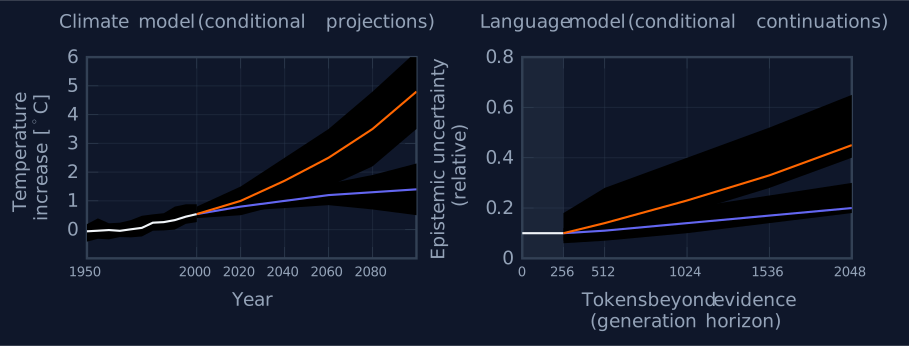
Climate science provides a useful mirror here, precisely because climate research has long been forced to develop a mature language for what a model is and is not. In climate science one distinguishes between scenario assumptions and models: a scenario provides conditions (e.g. future forcing), the model simulates a system given those conditions. The crucial point is that the result is understood as conditional. In a chaotic system, small differences in initial conditions and parameterization grow into large differences over time; forecasts develop spread. That spread is not a sign that the science is “worthless”, but a sign that models have domains where they are stable and domains where they become uncertain. Climate science has institutionalized something that AI rhetoric often lacks: a disciplined respect for the structure of uncertainty.
Language models behave similarly, but in another medium. When the context is simple, when the task sits close to the training distribution, and when there are strong textual patterns to follow, the model can be impressively stable. But as the context becomes complex, as the task demands exactness rather than plausibility, or as it must navigate goal conflicts and unstated assumptions, you get an analogue to a climate model’s spread: the model drifts toward well-written but incorrect continuations.
In the LLM world this is often called “hallucination”. The term is unfortunate, because it sounds like a strange deviation in an otherwise “rational” agent. In reality it is a normal outcome of a model whose optimization target is textual likelihood.
This is where the strategy’s language about “innovation” becomes epistemically charged. If one reads “AI can contribute to research and innovation” as meaning that the language model itself has inventive capacity --- the capacity to produce novel content in the sense of new knowledge --- then one attributes to the model a property it does not possess. A language model can produce new strings of text; it can recombine existing patterns in surprising ways; it can suggest hypotheses. But without an external mechanism of testing (experiments, measurement, tools with verifiability), it cannot distinguish a fertile new idea from a false new idea. In an epistemic sense it is therefore not an innovation actor, but a generator of proposals with unknown truth status.
Why, then, does this assumption take such a strong hold in policy? Here epistemology meets political economy. Describing “AI” as a general innovation force makes investments in data, cloud infrastructure, compute capacity, standardization, procurement, and public-sector adoption politically self-evident. The strategy thus functions not only as a description of technology, but as an incentive structure: it creates a situation where the question is no longer whether a given system is suitable for a given institutional practice, but how quickly the institution can scale its use.
In such a logic, throughput and surface quality (well-written briefs, shorter processing times, “automated” texts) are often rewarded, while epistemic qualities (truthfulness, traceable causal chains, calibrated uncertainty) become secondary --- until they suddenly reappear as political scandals.
Climate science teaches us that a model can be immensely valuable and still dangerous if mistaken for an oracle. The point here is not that “models are bad”, but that a model’s epistemology must precede its institutionalization. If the strategy wants to make “AI” into infrastructure across the state, business, and research, it must first be clear about what kind of prediction these systems actually perform, where their stable domains end, and what kinds of errors they produce when they cross the boundary. Otherwise we build a modernization agenda on a category error: from model to actor, from plausibility to knowledge.
3 What Can (In Good Faith) Be Read as Positive in the Strategy
One can read the strategy charitably as an attempt to at least acknowledge that “AI” is not a neutral technology. In the section “Human-centric approach”, it emphasizes that risks linked to bias --- “distortion, partiality, discrimination, misleading information and human rights violations” --- must be actively managed (2026, p. 15). The strategy also stresses transparency and accountability, particularly when AI is used in the exercise of public authority and in welfare services.
In principle, this is a step in the right direction: simply naming that the technology can carry and amplify norms, skew, and harm --- rather than describing it as purely “efficiency-enhancing”.
But there is a decisive asymmetry here: the strategy frames “bias” and “misleading information” as something one can administratively remove through guidelines and “active management”, rather than as a structural property of the models and of the production chain behind them.
For such management to be more than a normative declaration, two conditions are required.
First: insight. If we mean it when we say discrimination and deception must be “handled”, we must be able to inspect what the model was trained on, how it was trained, what filtering and reinforcement were applied, what evaluation metrics governed it, and how the system behaves in domains where mistakes are costly. This requires a level of transparency that in practice approaches a minimum requirement: a genuinely open model in the sense that architecture, code, and weights are available --- so the system can be run, audited, and modified without the vendor’s interpretive monopoly.
Second: a chain of responsibility. The strategy states that “AI users should be held responsible for both the intended and unintended consequences of its use” (2026, p. 15). This sounds self-evident, but in an ecosystem where the public sector purchases or dependency-integrates generative models, responsibility quickly becomes diffuse. Who bears responsibility for a faulty risk assessment, a skewed summary, an incorrect prioritization, an unreasonable written justification? In practice, responsibility often lands at the bottom of the chain --- case workers, teachers, social workers --- while control sits with the supplier or the infrastructure.
This is where “Swedish language models” become especially interesting. The strategy and its action plan point toward “language models built on material from Sweden” as a sovereignty project: higher linguistic quality, cultural adaptation, and reduced dependency. That is (at best) a legitimate ambition. But even a nationally anchored model is still a model. A “Swedish” model does not automatically become more legally robust, more truthful, or less discriminatory --- it becomes, at best, more locally fluent. And local fluency can itself be a risk: stylistically convincing errors are harder to detect.
The good-faith positive reading therefore ends in a demand: if the Swedish Government wants to connect “the human at the center” to practical governance, the strategy must more explicitly commit to verifiable transparency. Without that, “active management of bias” risks becoming an ethics gesture that legitimizes adoption without creating counter-power against the model’s intrinsic failure modes.
4 A More Radical View of LLM Suitability Is Needed
Even when it names risks, the strategy treats them as something that can be managed after the fact through guidelines, coordination, and “responsible use”. That is not sufficient. A language model is not merely “a technology” among others; it is a model with a specific epistemology: it produces plausible statements without an inherent link to truth. The question of rollout is therefore not primarily a question of pace and coordination, but of suitability.
To test suitability, we need to do what climate science has long been forced to do: begin with conditions, then delimit domain, and finally describe spread --- how errors arise, what they look like, and who pays when the model diverges. The following are three problem areas (among many) in the strategy’s approach to LLM adoption.
4.1 The Resource Regime: “Fossil-Free Electricity” Is Not an Ethical Free Pass
Conditions
The strategy describes Sweden’s strong starting point --- fossil-free electricity, a favorable climate for compute infrastructure, and the ambition to be Europe-leading in computing capacity. But those claims imply a condition rarely stated explicitly: that Sweden will become part of, and partially carry, a rapidly expanding industrial regime of computation.
LLMs are not only software. They are an infrastructural project: data centers, cooling, networks, cloud architectures, procurement, operations, and continuous scaling. And scaling is not a temporary phase but a built-in market driver: better models demand more data, more compute, more fine-tuning, more inference capacity, and deeper integration into everyday processes. A strategy that wants the public sector to be “best in the world” at use, while Sweden becomes “Europe-leading” in compute, effectively specifies a condition: continuously increasing compute consumption.
Domain
It is easy to reduce the political domain here to electricity and climate: how much power is needed, how to plan the grid, whether waste heat can be reused, whether energy performance can be reported. The strategy’s action plan includes measures on data centers and energy dialogue; that is not irrelevant. But it is a narrow domain.
Taking the LLM industry as a whole, we must also see another domain: material and geopolitical supply chains. The global AI economy rests on a value chain whose bottlenecks and power concentrate around:
- semiconductors and advanced chip production,
- specialized equipment and expertise concentrated in a small number of countries and firms,
- mineral and raw-material chains, including critical materials, and
- a division of labor where costs (environment, health, labor conditions) are often externalized far away from the institutions that “benefit” from the technology.
The strategy acknowledges dependencies and Sweden’s ambition to strengthen its role, but it does not address the central ethical question: that a national “AI push” can become a way of importing a resource- and exploitation-regime under modernization rhetoric. Fossil-free electricity can reduce some emissions in Sweden, but it does not solve the questions of raw materials, depletion, local environmental impacts, or exploitation in extraction.
In other words: fossil-free electricity is not an ethical free pass; it is one component of a much larger bill.
Spread
In climate science, spread is a consequence of sensitivity and assumptions. In the LLM economy there is another kind of spread: costs diffuse through the chain and become invisible to the institutions making adoption decisions. When the public sector deploys LLM support at scale it often appears as “just another digitalization initiative”, yet behind the surface demand rises for compute, chips, data-center expansion, and global raw materials. That spread is especially hard to hold accountable because it is systemic: no single agency “causes” it, but the aggregate does.
A strategy serious about sustainability would therefore distinguish clearly between two questions: (1) can AI help optimize certain systems? and (2) what systems must be built for AI to become everyday infrastructure, and what social and material costs follow? Without that distinction, “sustainable AI” becomes a slogan rather than an analysis.
4.2 Militarization: When “AI” Becomes a Word That Makes Capacity for Violence Ordinary
Conditions
The strategy has a clear security and defense track. It describes AI as a strategic resource in total defense, and mentions autonomous systems, AI-driven intelligence processing, and advanced sensor analysis (2026, p. 11). This is, in itself, accurate: digital technology and automation change the conditions for security.
But a crucial condition is treated too shallowly: when the state builds capacity, competence, and infrastructure for “AI” in security domains, the likelihood increases that language models and generative systems are used as interpretation machines in decision and targeting chains. This does not necessarily happen through an explicit decision to “let a model decide”, but through organizational logic: when the system exists, when speed pressure exists, when staffing shortages exist, and when interoperability and data volumes increase, it becomes rational to use the model to summarize, prioritize, propose, and categorize.
Domain
Many want to keep the discussion of military AI limited to drones and “weapons systems”. But the language model’s domain in defense and security often lies earlier in the chain: planning, intelligence synthesis, threat framing, target prioritization, operational recommendations, “strategic options”. It is precisely in these domains that language models are dangerous in a specific way: they are good at producing coherent narratives and justifications even when the underlying basis is weak.
This is not moral panic, but an epistemic observation: a system optimized for plausibility is tempting in domains where information is fragmentary and time is scarce. Yet those are exactly the domains where errors have high cost. In climate science it would be like treating an ensemble’s spread as irrelevant “noise” and still making decisions as if the forecast were uniquely determined.
Spread
Here spread takes a particularly dangerous form: normalization. If generative systems are used to produce strategic briefs and prioritization, a habit forms of accepting the model’s form as decision-relevant. This is an institutional drift from “a tool for text” to “a tool for judgement”. And once judgement is outsourced in practice --- even partially --- the chain of responsibility changes: the human decision-maker receives a brief that looks well grounded, while the causal chain is opaque. That makes it harder to detect when the system diverges.
A radical critique here is therefore simple: the strategy speaks about AI’s role in defense but avoids problematizing the language model’s specific failure mode in decision support. It says risks must be managed, but it does not explain how one manages a system that can produce persuasive errors with the same rhetorical weight as correct analysis.
4.3 Schooling: From Civic Education to the Normalization of Epistemic Shortcuts
Conditions
The strategy explicitly states that schooling and higher education must prepare individuals for a working and civic life in which digitalization and AI are included. On the surface this is obvious: school must relate to its time. But the formulation also functions as a political condition: it makes language-model adoption a taken-for-granted future and shifts the school’s mission from critical examination to adaptation.
This is where suitability becomes most crucial. School is not only a supplier of labor-market skills; it is an institution for civic education and epistemic formation: the capacity to read, write, argue, test, evaluate sources, and distinguish plausibility from truth. Making language models “present in teaching” without first clarifying what they are and what errors they produce risks turning school into an adoption engine for epistemic shortcuts.
Domain
The reasonable domain claim is: students must understand that language models exist, how they are used, and what risks they pose in public life and work (disinformation, manipulation, automated texts, bias). That is one thing. The problematic domain claim --- into which the strategy’s language can easily slide --- is: students should use language models as standard tools for thinking, writing, problem solving, and knowledge production.
The reason for skepticism is not moralism (“students cheat”), but epistemology: language models produce a textual ‘answer’ without any guarantee of truth, without a traceable causal chain, and without stable self-knowledge about when they are uncertain. Normalizing them as learning tools risks establishing a culture where linguistic fluency and surface correctness matter more than understanding and testability. It is a kind of “model damage”: the institution trains itself to interpret plausible answers as knowledge.
Spread
Here spread is twofold. First, spread as error: when students use the model in complex tasks, it will sometimes be correct, sometimes wrong, often confident. Second, a longer-term spread of epistemic norms: if school makes language models everyday infrastructure, students habituate to knowledge as something one fetches as a text product rather than something one constructs and defends through argument, testing, and method.
A more reasonable education-policy stance would therefore be the reverse: not that school should “introduce” language models, but that school should cultivate a critical understanding of them as a societal technology --- teaching about language models, not teaching with language models as default support in the core learning process. That distinction is decisive if we take the school’s Bildung mission seriously.
5 Conclusion
The strategy’s central problem is not that it misses “a few risks”, but that it performs a category error as policy: it treats a language model as if it were a knowledge actor with judgement and innovative capacity. The focus thus shifts from the model’s conditional nature --- its assumptions, domain, and failure mode --- to a narrative of national positioning and rapid implementation.
The consequence is that societal institutions are built around a system whose strength is linguistic plausibility, not epistemic reliability. When a plausibility machine is installed in environments that require truth, traceability, and responsibility, the model’s errors risk being normalized as “efficiency” and “digital maturity” --- and therefore become harder to detect, audit, and contest.
This is not an argument for “braking our way into the future”. It is an argument against replacing suitability assessments with ranking ambitions. In climate science it would be unthinkable to build societal planning on a model without simultaneously stating assumptions, spread, and domains. Yet this is exactly the shift the strategy risks making with language models: from model to actor, from conditional output to societal infrastructure.